Coming soon · iOS & Apple Watch

Marathon-grade
training plans built
around your fitness.

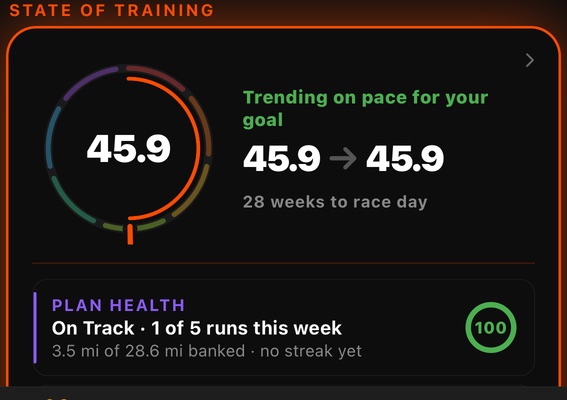
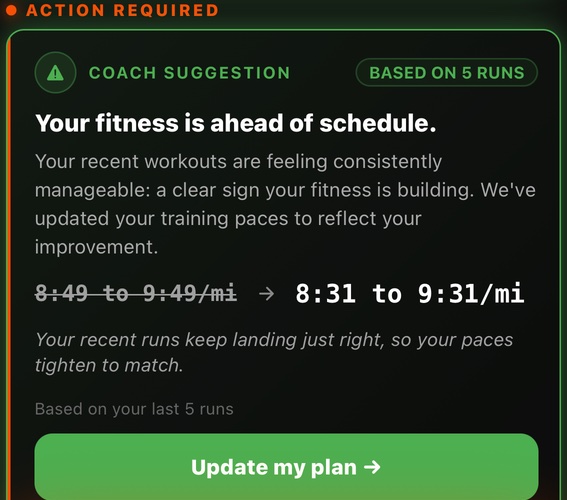
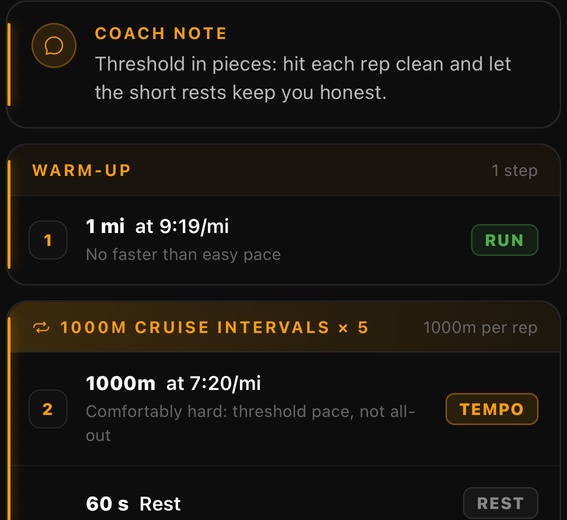
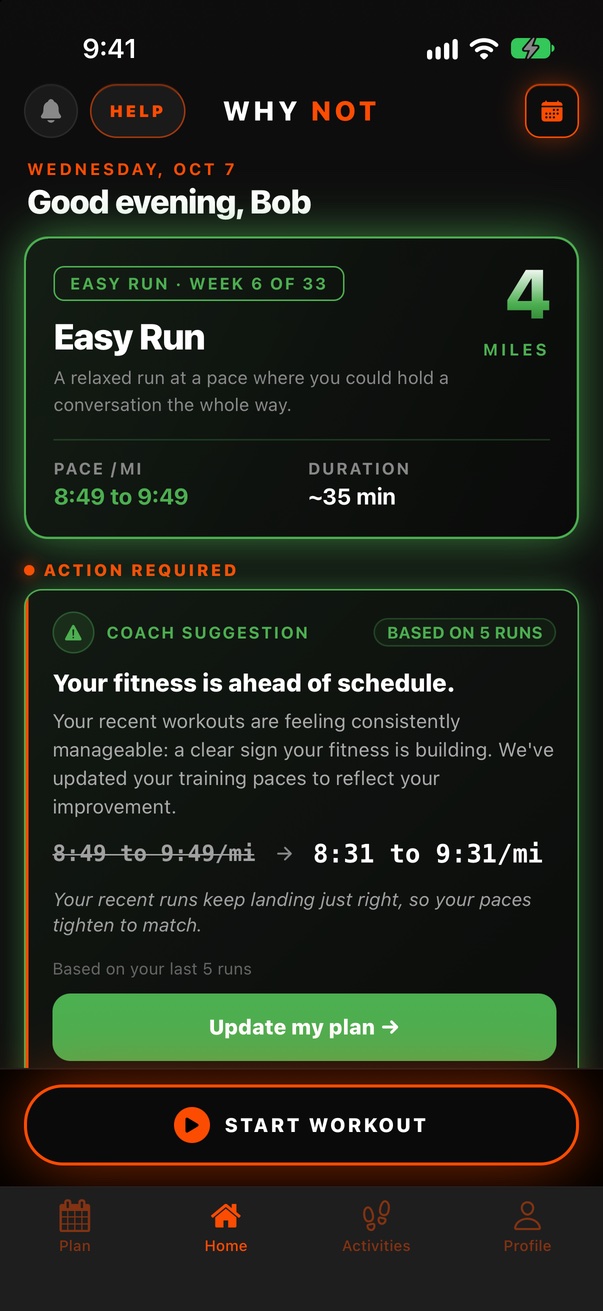
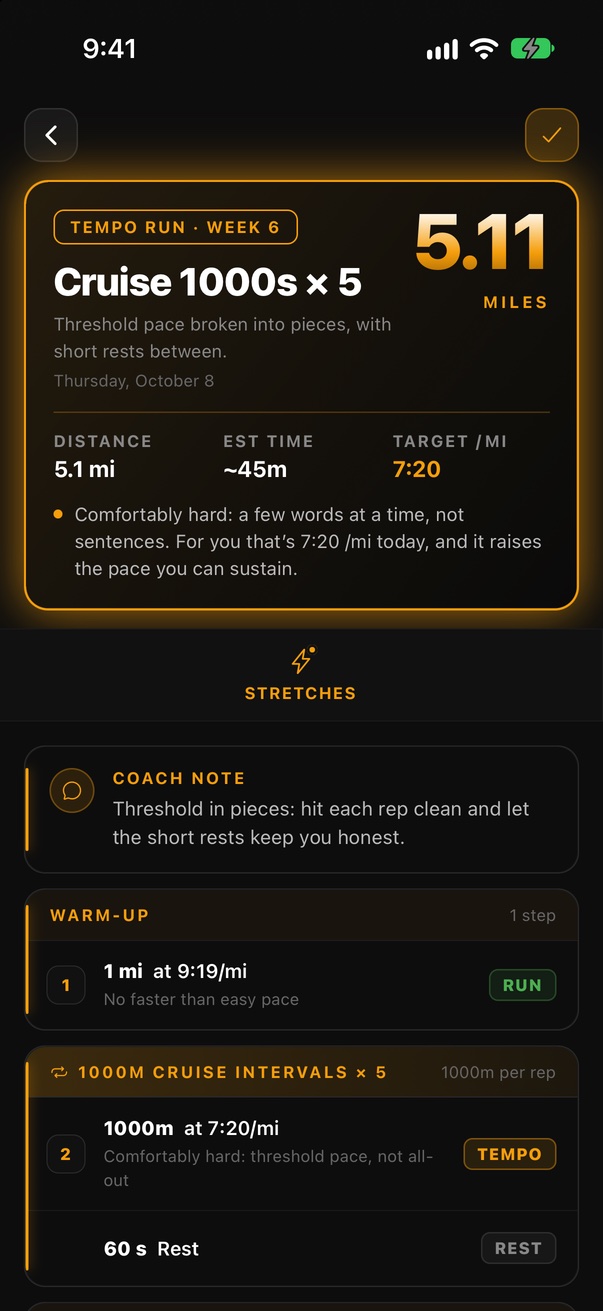
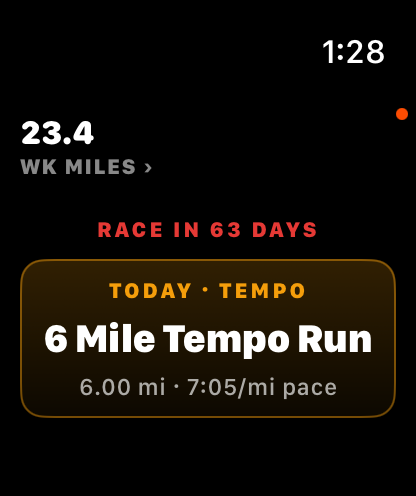
Adaptive plans for 5K to ultra that rewrite themselves as you train. Real coach voice during your runs. VDOT-based pace zones tuned to your fitness, not a generic level. A plan that pivots when you're sick, hurt, or just had a bad week.

How it works
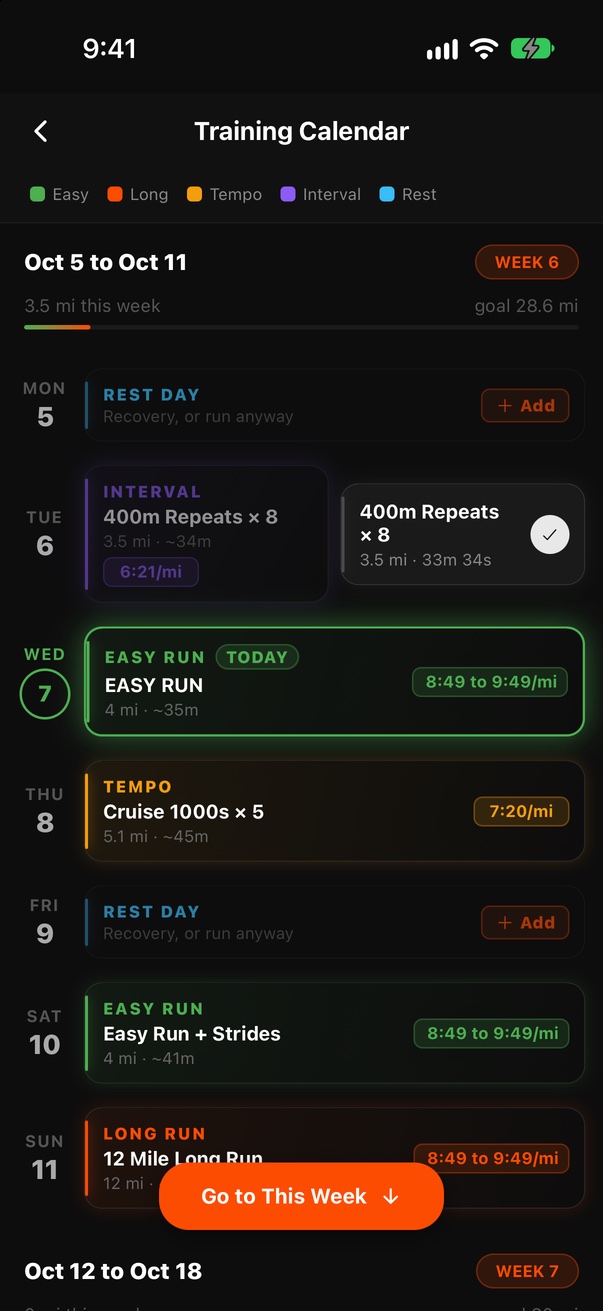
Training calendar showing weekly workouts
🗓️
races/calendar.jpg
Training Calendar
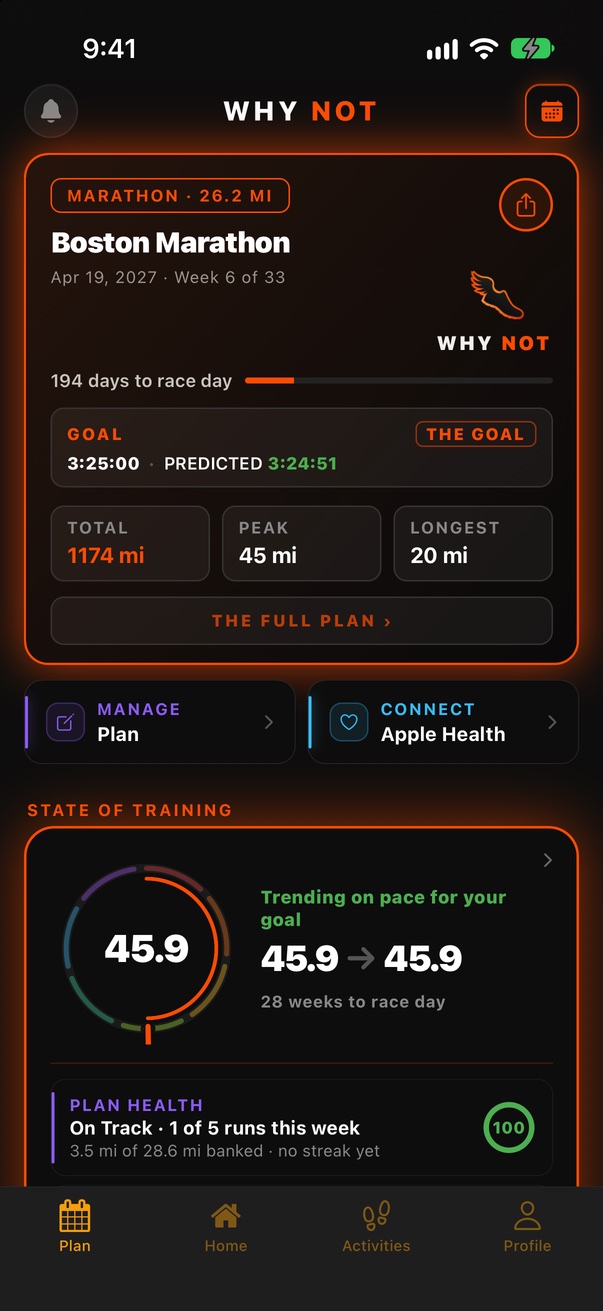
Plan tab showing race countdown, plan health, injury risk and race predictor
🎯
races/plan.jpg
Plan tab
VO2 Max screen showing fitness brackets and current score
📊
races/vo2.jpg
VO2 Max

Built by a runner.
Not a venture-backed
running app.

Why Not is the independent alternative. iPhone-native. Apple Watch-first. Your data stays yours. No upsells, no premium tiers, no investor breathing down anyone's neck.

From the founder

My first marathon was Boston 2023 — I ran 4:45 and was wrecked. Three years later, Boston 2026, I came back and ran 3:20. Every running app I tried along the way was charging $99–240 a year for what's basically a generated plan and a stopwatch with voice cues. So I built the alternative — same training engine, half the price.

Bobby · Founder, solo developer
Bobby — Founder, Why Not
1
Developer
$0
Investor money
0
Data sold
$59.99
Per year
WHY NOT
LACE UP. WE'VE GOT THE REST.
What you get

A real coach. No middlemen.

Built around how runners actually train, not how subscription apps want you to. No social feed obligation. No data harvesting. No premium tier dangling above the basic one. Every feature is here because it earns its place.

🏠

Independent

One developer. No investors. No upsells, no premium tiers, no growth-team pressure to bolt on features that don't matter. Same training engine forever, same price.

🔒

Your data stays yours

No tracking pixels. No analytics SDKs. No leaderboard you didn't ask for. Your training data lives on your phone — not in our database, because we don't have one.

📈

Adaptive plans

Plans recalibrate as you log runs. Not a generic PDF. Built around your goal, your pace, your schedule. VDOT-based pace zones, periodized blocks, the real thing.

🎙️

Real coach voice

Pace targets, step-by-step structure, voice cues during your run. Directive. No filler. Like a coach who actually shows up.

🛡️

Pause when life happens

Sick? Hurt? Travel week? Pause your plan for 1–14 days. The plan picks up where you left off, no manual rescheduling.

Apple Watch-first

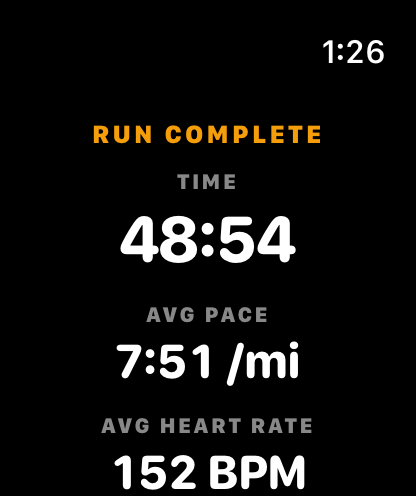
Designed iPhone-native, Apple Watch first. But Apple Health sync covers Garmin, Coros, Polar — anything that talks to Health. Use your watch. We don't care which one.

Plans we cover

Every distance. Every level.

Pick a goal. We build the plan. Couch to 5K all the way to ultramarathon — same engine, same subscription, same indie developer keeping it sharp.

🏃
Couch to 5K
8 weeks · 3 days/wk
5K Race
8–12 weeks · sub-25 to elite
🎯
10K Race
10–14 weeks · all paces
🏁
Half Marathon
12–16 weeks · sub-2 to elite
🏔️
Ultra (50K–100M)
16–24 weeks · trail or road
📍
Hit a Distance
No race? Just a goal mileage
🔄
Maintenance
Stay fit between race cycles
The honest comparison

What you get vs what you give up.

Strava acquired Runna in April 2025. Different apps, separate subscriptions. Garmin gates everything behind their watches. Nike Run Club is free — for now. We're showing the math, the gaps, and what each option costs you beyond just dollars. Decide for yourself.

Other coaching apps
Free trackers
Why Not
Annual price
$80–$120 / year
Free + paywalls
$59.99 / year
Monthly option
$10–$20 / month
N/A
$7.99 / month
Independent
VC-backed or acquired
Owned by Nike, Strava, etc.
Solo developer
Built around training
Yes
Social-first
Yes
No social feed obligation
Mostly
Feed is the product
No feed at all
No data harvesting
Aggregated & shared
Marketing data
Stays on your phone
Use any watch
Most
~ Brand-locked best
Yes — via Apple Health
Adaptive plans
Most
Static or none
Yes
Pause your plan
No
No
Built in
Real coach voice
Some
No
Yes
VO2 Max tracking
Rare
No
Yes
Free trial
7 days
Always free
7 days
Cancel any time
Yes
Yes
Yes

"Other coaching apps" reflects the Runna / TrainingPeaks / Strava Premium tier. "Free trackers" includes Nike Run Club, Strava free, and similar.
Pricing reflects category averages as of May 2026. Subject to change at the providers' discretion.

How it works

Four steps. No fluff.

Onboarding takes about 2 minutes. We don't ask you to create an account with us — there's no account to create, because we don't have a user database. Open the app, tell it your goal, run.

01

Tell us your goal

5K, marathon, ultra, or just "I want to run more." Pick a race date or skip it. We build the plan.

02

Connect Apple Health

Optional but recommended. Sync runs from your Apple Watch, Garmin, Coros, Polar — anything that talks to Apple Health. Read access only. No write-back, no aggregation.

03

Open the app, tap Start

Today's workout is on the home screen. Pace targets, voice cues, structure — all handled. You just run.

04

Get faster, week by week

The plan adapts. VO2 Max climbs. Race day comes around and you're ready. No social-feed validation required.

Why does this exist?

Because indie running apps deserve to exist too.

Strava bought Runna. Nike runs NRC. Garmin gates Garmin Coach behind a $400 watch. Apple does what Apple does. The running app category is consolidating — and that's fine, the big players make great products. But "consolidating" means the assumption is creeping in that there are only a few right answers and they all live inside someone's ecosystem. Why Not exists because that's not actually true. A running app can be one developer who's a real runner. It can be ecosystem-agnostic. It can not have a marketing team. It can stay the same price next year because there's no investor pushing for ARR growth. That's a category that should exist alongside the venture-backed and acquired players — and now it does.

🧱

Independent by architecture

Not a startup that hasn't raised yet. Not a side project until it gets real. Solo developer, profitable at 1,000 subscribers, no fundraising on the roadmap. Stays this way on purpose.

🌐

No ecosystem capture

Use any watch. Use any GPS device. Apple Health is the only integration we require, and that's because it's the open hub — not because we're trying to lock you anywhere.

🏃‍♂️

Founder-built, un-copyable

4:45 to 3:20 in three years. Every product decision passes through that runner's lens. You can copy a feature, but you can't copy an 85-minute marathon improvement.

Questions, answered honestly

FAQ

Three real differences:

Architecture. Solo developer. Not VC-backed, not acquired, not a shoe company's marketing arm. The whole app fits in one person's head.

Philosophy. No data harvesting, no upsells, no premium tier, no social feed obligation. Your training data lives on your phone — there's literally no server collecting it.

Plan quality. Adaptive plans tuned to your fitness, not generic ones. Nike Run Club's free plans don't adapt to what you actually run — they're static templates. Why Not's recalibrate every week based on your VDOT and the runs you actually log.

Price. $7.99/month or $59.99/year. Half of Runna. If price isn't your concern, the first three reasons matter more.

The app keeps working. Plans are generated locally, your data is on your phone, and there's no server that has to stay online for it to function. If I disappear, your training history stays yours — you'd just stop getting updates. I have no plans to disappear, but the architecture means you're not at risk if I do.

You get a full 7-day free trial when you sign up. Pick monthly ($7.99) or annual ($59.99) at signup, and Apple won't charge you until day 7. Cancel any time during the trial in your iPhone's Settings → Subscriptions → Why Not, and you pay nothing.

Yes. Cancel through your iPhone's Settings → your name → Subscriptions → Why Not → Cancel Subscription. You keep full access until the end of your current paid period. Your training history stays on your phone in read-only mode after that.

Because the moment you raise venture capital, the entire product roadmap reshapes around growth. Features get added because they justify a Series A, not because runners need them. Prices creep up because investors need ARR growth. I'd rather build the small profitable indie running app than the next subscription monster. If you've watched what happened to a few of the apps in this category over the past five years, you know what I mean.

No. The app works fine with just your phone — pace via GPS, voice cues via headphones, structure on screen. A watch makes it nicer, especially Apple Watch since the app is iPhone-native and Apple Watch ships at v1 launch. Garmin and Coros work via Apple Health sync. We don't care which watch you wear.

iOS first. Android is on the roadmap. The plan engine is already cross-platform under the hood (React Native), so the wait is App Store approval and Play Store setup, not engineering.

If we ever change pricing, Apple requires us to notify existing subscribers in advance and give you the option to cancel before the new price takes effect. There's no investor pressuring me to bump prices to hit a number — so the honest answer is: not anytime soon.

Both. Plans cover Couch-to-5K all the way through ultramarathon. Same engine. Sarah training for her first half and Marcus chasing a sub-3 marathon both use the same app — the plan just looks different for each of them.

WHY NOT.

indie. iphone-native. runner-built.
7 days free $7.99 / month $59.99 / year

Drop your email and we'll let you know the moment it ships. No spam, no marketing funnel — there isn't a marketing team. Just one runner letting you know when the trial's available.