Goal finish
A training plan for your HYROX race
Half of HYROX is running.
Train it like a runner.
A HYROX race is 8 km of running and eight stations. Why Not is a running coach for iPhone and Apple Watch that also builds the station work: every session at your division’s race weights, from your first race to a competitive one, 2 to 16 weeks to your race day.
The race: eight runs, eight stations.
A 1 km run, then a station, eight times, in this order. The running distance is the same for every division; the loads change. The Roxzone is the floor between the run course and the stations that every transition crosses, and it has a time of its own.
1 km run
1
SkiErg
1000 m
1 km run
2
Sled push
50 m
1 km run
3
Sled pull
50 m
1 km run
4
Burpee broad jumps
80 m
1 km run
5
Rowing
1000 m
1 km run
6
Farmers carry
200 m
1 km run
7
Sandbag lunges
100 m
1 km run
8
Wall balls
100 reps
Format and doses from the HYROX Singles rulebook, season 26/27. Loads by division are on the weights page and on each station’s page.
Half the race is running.
Eight kilometres of running, in one-kilometre pieces between stations, and every station done on legs that have just run. Why Not starts from the running and builds the stations around it.
The running half
8 × 1 km
Race pace repeats every week, a tempo day, an easy run that grows through the plan, and your race legs at one pace: the faster of your goal’s leg pace and the pace your own running already holds.
The station half
8 stations
A circuit a week at your division’s race weights, a lifting day, and bricks: 1 km run, then a station, five or six times. Simulations of the race, scheduled, never every week.
Inside the app.
Real screens of the plan the app built for Bob, Open men, Average, with a Sunday race in Boston. Nothing drawn.
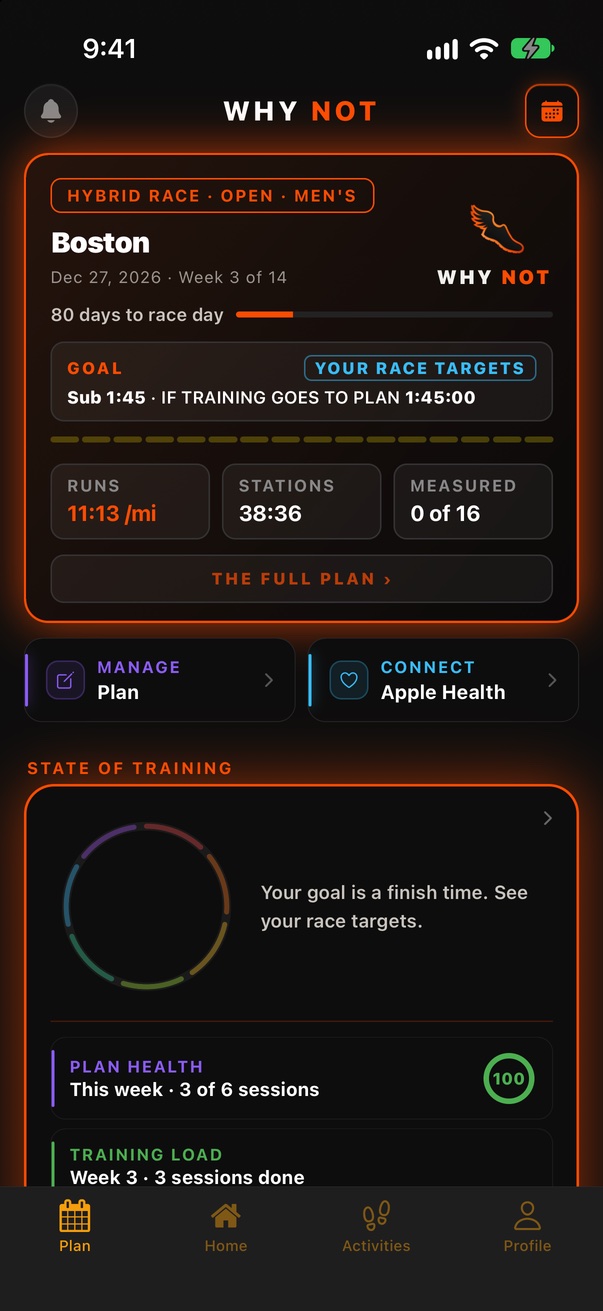
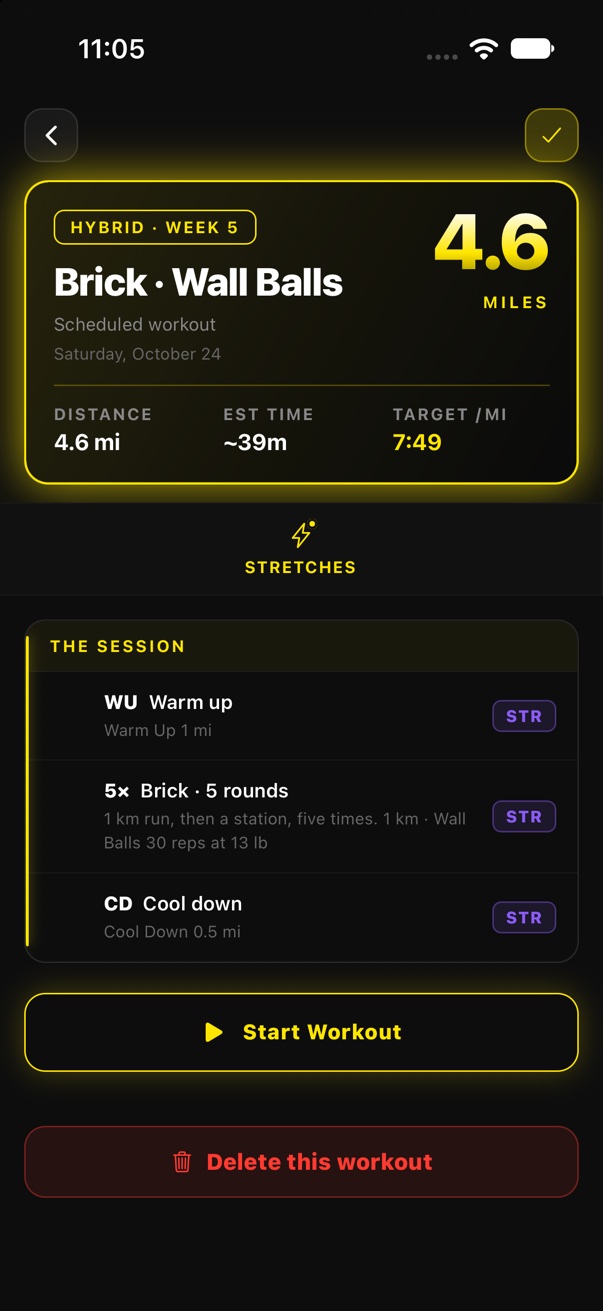
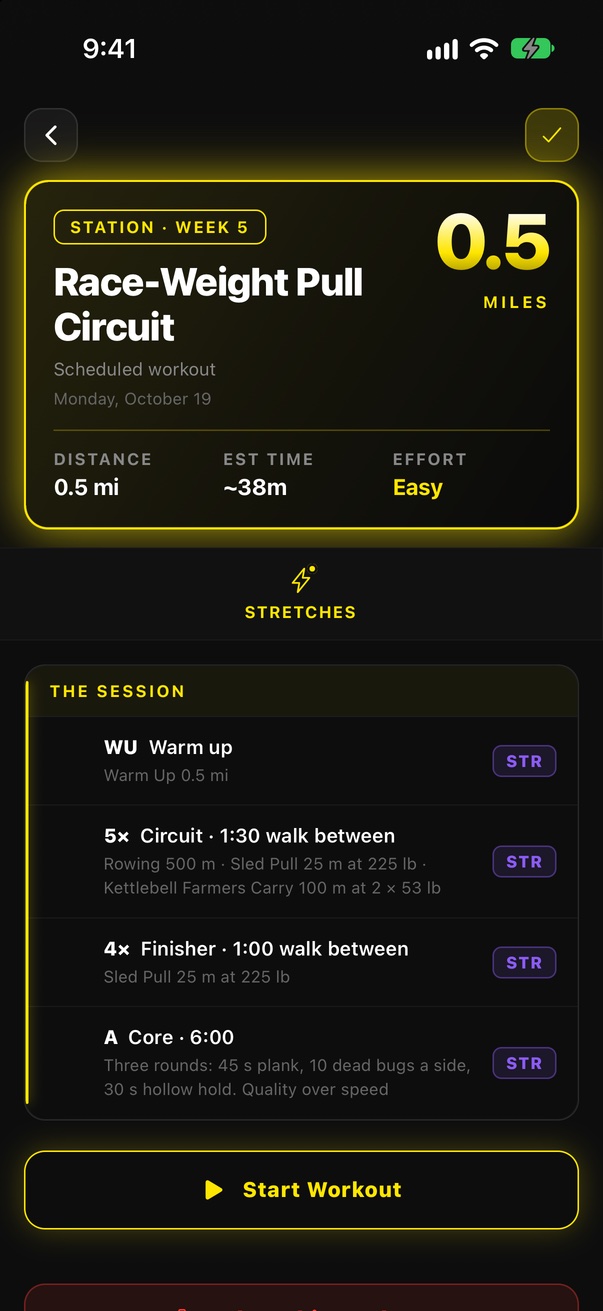
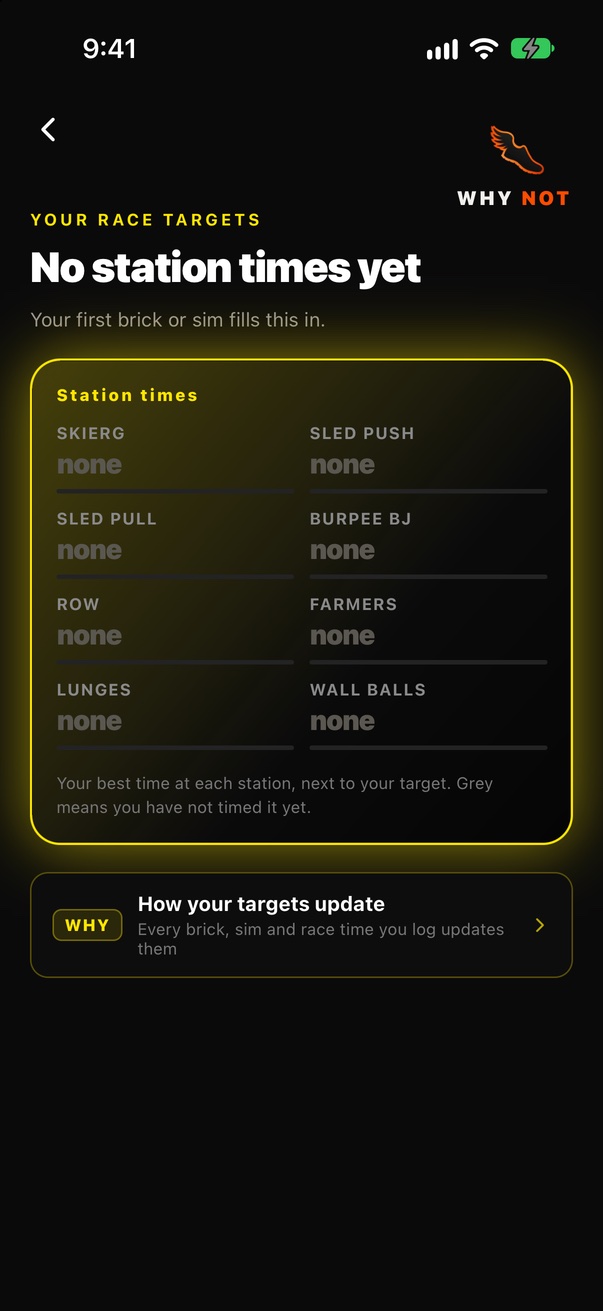
A week, as the app builds it.
Week 5 of Bob’s plan, straight from the generator. Six days on his own week (gym Monday and Wednesday, runs Tuesday and Thursday, the brick Saturday, the easy run Sunday), every load his Open men’s race weight.
Mon
Station
Race-Weight Pull Circuit
5 rounds: 500 m row, 25 m sled pull at 103 kg (225 lb), 100 m farmers carry at 2 × 24 kg (2 × 53 lb), 90 s walk between rounds. Finisher: 4 × 25 m sled pull at 103 kg (225 lb) with 60 s walk.
Tue
Tempo
Tempo and 400s
2 mi at 7:31/mi, 3 minutes rest, then 4 × 400m faster with 60 seconds rest between.
Wed
Strength
Strength · Lower
Back squat or deadlift 4 × 6 · Romanian deadlift 3 × 8 · step-ups 3 × 10 a leg · heavy sled push 4 × 25 m at 110 to 120% of 152 kg (335 lb) · walking lunges 2 × 20.
Thu
Race effort
Race pace · 6 × 1 km
6 × 1 km at 7:49/mi with 90 seconds walking between. Same split every rep.
Fri
Rest
Rest Day
Recovery is where the work sticks.
Sat
Brick
Brick · Wall Balls
5 × (1 km at 7:49/mi, then 30 wall balls at 6 kg (13 lb)) 1 mi warm up, 0.5 mi cool down.
Sun
Easy
Easy run · 4.5 mi
4.5 miles at 9:02/mi. Easy effort: you should be able to talk.
Bob’s phone is set to miles, so the app prints his loads in pounds; here they read kilograms first, as the rulebook prints them. His paces are a mile’s. The full 14 weeks are on the training plan page.
Three levels. One question.
The app asks which engine you have been feeding, and builds the week from the answer.
Level 1
Beginner
New to this. Some running or some gym, not both yet.
- Weeks 1 and 2 are skill sessions: all eight stations at 50 to 60 percent of race weight, technique cues first
- Every load reads “up to”: race weight is the target by race week, not today’s number
- The brick from week 2; repeats up to 6 × 1 km; the fourth run easy, not a tempo
- The easy run grows to 5 miles
Level 2
Average
You run and train most weeks.
- The brick from week 1; race-weight circuits from the build
- A tempo day every week
- Repeats up to 7 × 1 km
- The easy run grows to 6 miles
- Bob’s plan above is this level
Level 3
Advanced
You have raced before, or you train hard six days a week.
- Advanced circuits from week 1, six rounds at race weight
- A 5 mile tempo; repeats to the race’s own 8 × 1 km
- Peak bricks with two stations after a leg
- The easy run grows to 8 miles
Every level trains at your division’s loads: Open or Pro, men’s or women’s, and for doubles and relay the Open loads of your own category (a mixed doubles pair both work the men’s Open loads, as the rulebook has it). Your week is yours: tap each day run, gym, both or off, and the plan places the brick on a both day and the easy run on the run day farthest from it.
What a finish time is made of.
Pick a goal and the calculator splits it the way the app’s station board does: eight run legs, eight station times and the Roxzone. Estimates from published results, replaced by your own times once you log sessions.
8 + 8 + the Roxzone
Type a goal finish, or tap one above, and the board fills in: every run leg, every station, the floor between them.Run legs
Stations
eight stations
Roxzone
every transition, plus the first minute
The eight run legs
The eight stations
| Station | Dose | Your load | Target |
|---|
Honest label. The station and Roxzone times are estimates: published averages of athletes around each finish, scaled so the parts add up to your goal, with the first minute held out for the start corral and the finish line. Men's and women's read the same table for now. The loads are the season 26/27 rulebook's. In the app, every brick, simulation and race time you log replaces a target with your own best. Nothing here is a promise.
What the app does.
- Every run on your Apple Watch. The 1 km repeats, the tempo and the easy runs run from the wrist, step by step, with the pace each step asks for. The station sessions, the bricks and the simulations run on the phone, which times each station. Station steps are not on the watch yet.
- Your race legs at one pace. The faster of your goal’s leg pace and the pace your own running already holds: from the recent 5K you give the app, or from your level when you give none.
- The station board. A target for every station from your goal; every brick, simulation and race time you log records your best. A station more than a tenth and more than 45 seconds behind its target is your slowest station, and your next two gym sessions end with extra work on it.
- Your gym, not a dream gym. Turn off what your gym lacks and every session swaps it by rule: row the SkiErg’s meters, bear crawl the sled’s, thrusters for the wall. The plan says so on every session a swap touches.
- A plan that reads your morning. On a low readiness morning a heavy station session becomes skill work at 60 percent load, and a brick day an easy run. Same day, lighter session.
Free and paid. Your plan, today’s session, the runner on the phone and the watch for the runs are free. The read after each session, the station board filling in from your sessions, the projected finish kept live on the Plan tab, the calendar and the plan controls are part of premium: 7 days free, then $9.99 a month or $79.99 a year.
Everything on HYROX here.
The training plan
How the weeks build, the three levels, the taper
8 week plan
Base, build, peak, race week
12 week plan
Two deloads, both half simulations
16 week plan
The longest the app builds
Your first HYROX
The beginner level, skill sessions first
HYROX for runners
What a runner keeps and what changes
The weights by division
Open, Pro, doubles and relay, kg and lb
The eight stations
Distance, weight, how to train each, the swap
The HYROX calculator
A goal finish split into legs, stations and the Roxzone
The HYROX pace converter
Your 1 km leg in mile pace, and the eight legs added up
The eight stations.
1 · SkiErg
1000 m, no load
2 · Sled push
50 m, 152 kg (335 lb) Open men
3 · Sled pull
50 m, 103 kg (225 lb) Open men
4 · Burpee broad jumps
80 m, no load
5 · Rowing
1000 m, no load
6 · Farmers carry
200 m, 2 × 24 kg (2 × 53 lb) Open men
7 · Sandbag lunges
100 m, 20 kg (44 lb) Open men
8 · Wall balls
100 reps, 6 kg (13 lb) Open men
Questions, answered honestly.
No. Why Not is an independent running coach for iPhone. Its Hybrid Race plan trains you for your HYROX race. Why Not is not affiliated with or endorsed by HYROX.
From two to sixteen weeks, set by your race date. Six weeks and up has a base phase; under six goes straight to race work. A race more than sixteen weeks out starts its plan sixteen weeks before race day.
Turn the sled off on the gym screen and every session swaps it: a bear crawl for the same meters where there is open floor, or a heavy incline walk on a treadmill. A sled with no turf lane keeps the sled on rubber at 15 percent less load. Every swap is a rule, shown on each session it touches.
The watch app runs the plan’s runs: the 1 km repeats, the tempo and the easy runs, step by step. The station circuits, the bricks and the simulations run on the phone, which times each station for your board. Station steps are not on the watch yet.
Your plan, today’s session, the runner on the phone and the watch for the runs are free. The read after each session, the station board filling in from your sessions, the projected finish kept live on the Plan tab, the calendar and the plan controls are part of premium: 7 days free, then $9.99 a month or $79.99 a year.
From your goal finish. Each goal is split into eight run legs, eight station times and the Roxzone, from published results. They are estimates and the app says so. Your own times replace them as you log bricks and simulations.
Why Not, the app
Not in the App Store yet.
Leave an email and get one message when Why Not is live, with the Hybrid Race plan in it. Nothing else, ever.
7 day free trial · $9.99/month · $79.99/year · iPhone & Apple Watch
Why Not is not affiliated with or endorsed by HYROX. HYROX is a trademark of HYROX World GmbH. Race format and loads from the HYROX Singles rulebook, season 26/27.